Square metre for square metre, Monaco may hold more art in its streets than any other country. More than 200 sculptures, mosaics and installations stand in the open air — Calder by the beach, de Chirico on the Rock, an Anish Kapoor on the casino square — and every one of them is free to see, at any hour, in any season.
This is no accident. Prince Rainier III bought and commissioned art for the public space for decades, and the state now curates the collection as the Chemin des Sculptures Rainier III, an official trail with its own map and fact sheets. This guide covers the works worth crossing town for, district by district — including the biggest one of all, which most visitors never see.
How a two-square-kilometre country became an open-air museum
The collection is largely one prince’s doing. Between the late 1980s and the early 2000s, Rainier III used the Monte-Carlo International Sculpture Festival and a steady acquisition policy to place hundreds of works in Monaco’s streets, gardens and squares — modern masters alongside commissions from artists who worked in the principality itself.
In 2023, for the centenary of his birth, the Direction des Affaires Culturelles formalised the legacy as the Chemin des Sculptures Rainier III, an official heritage trail of more than 200 works, each with a QR-linked fact sheet and a place on an interactive map. You could follow it exhaustively for days; the sections below pick the essentials.
Fontvieille: the sculpture park
The densest concentration is in Fontvieille, the district reclaimed from the sea — its park and rose garden double as Monaco’s sculpture garden. Within a few hundred metres you pass Arman’s Cavalleria Eroica, François-Xavier Lalanne’s Grande Carpe (his whimsical bestiary continues nearby — look for the Great Bear and the harnessed donkey), the surrealist Frère et Sœur by André Masson and Victor Ochoa’s anguished Torso Desperacion.
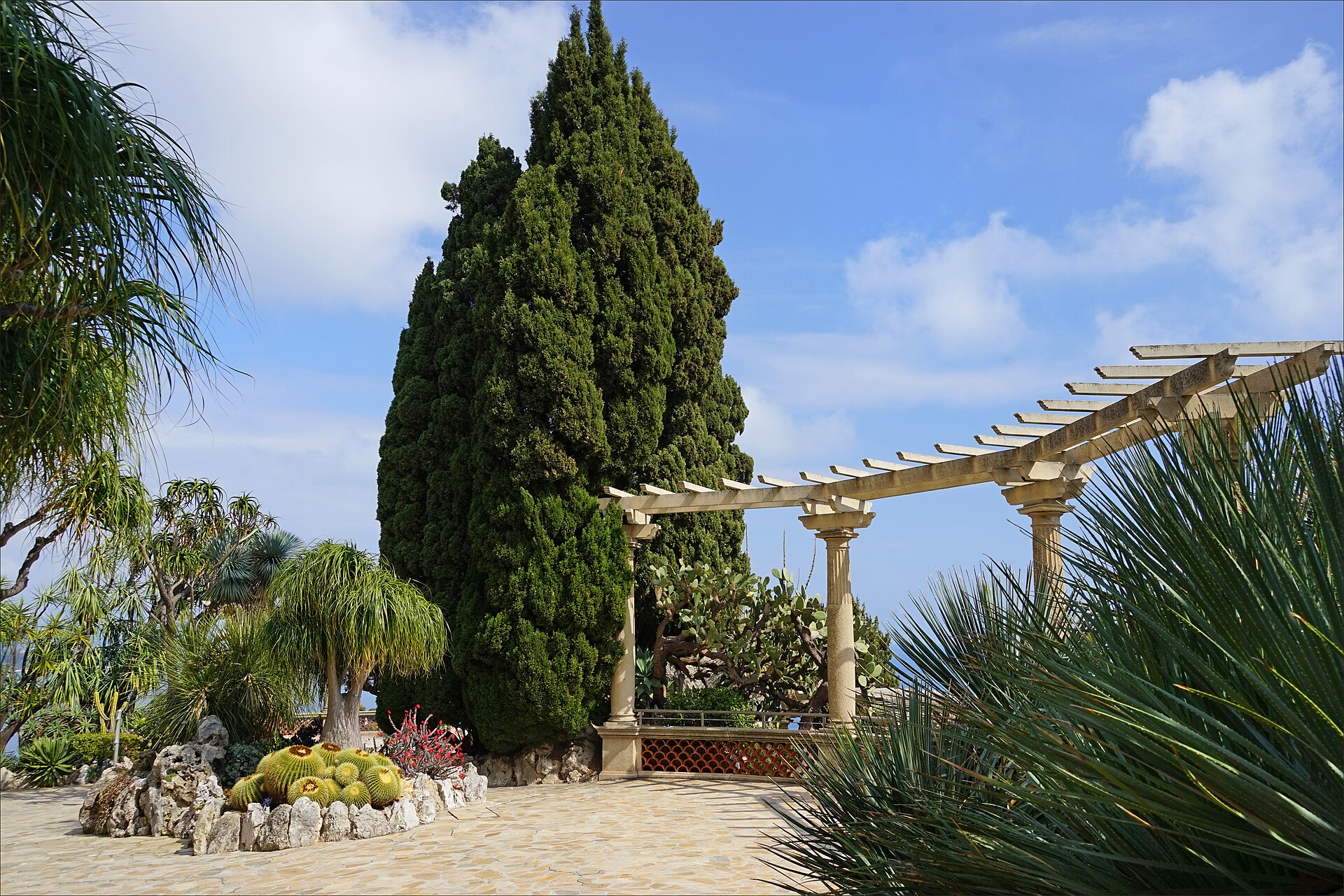
The Jardin de l’UNESCO above the Fontvieille port folds more works into four hectares of Mediterranean planting — Alessandro Montalbano’s Et le septième jour among them — with the cliffs of the Rock and the Prince’s Palace as backdrop. Come for the art, stay for the view.
Places


The Rock: myth, memory and a surrealist masterpiece
Monaco-Ville carries the collection’s storytelling layer. Near the Prince’s Palace, Kees Verkade’s Malizia shows François Grimaldi with a sword hidden beneath his monk’s robe — the 1297 ruse that won the dynasty its fortress, cast in bronze for the 700th anniversary.
A few lanes away stands the finest single work on the Rock: Ettore e Andromaca by Giorgio de Chirico, his metaphysical mannequin lovers frozen in a farewell — a museum-grade surrealist landmark that most visitors walk past without noticing. The Jardins de Saint-Martin add the nineteenth-century layer, with busts of Empress Eugénie and others among the sea-cliff paths, and Emma de Sigaldi’s La Pieuvre — an octopus in bronze — guards the approach to the Oceanographic Museum.
Places


The port: racing bronze and a wandering king
At the Sainte-Dévote corner of the Grand Prix circuit, the William Grover-Williams Memorial freezes the winner of the very first Monaco Grand Prix — 1929, in a Bugatti 35B — mid-lap in bronze. Every Formula 1 field since has, in effect, raced past its own origin story.
Along Port Hercule, Anna Chromý’s Ulysses watches the harbour that has received seafarers since antiquity, while a street inland Giacomo Manzù’s Tebe in costume brings a work by one of Italy’s great modern sculptors to La Condamine. Portside, the Salle d’Exposition on Quai Antoine 1er stages rotating shows if you want walls and a roof with your art.
Places


Monte-Carlo: the blue-chip quarter — and the artwork you can’t see from the street
The Casino quarter holds the marquee names. On the Place du Casino itself, Anish Kapoor’s Sky Mirror — a polished steel disc, a gift of Lily Safra — folds the Riviera sky and the Belle Époque façade into one shimmering frame. On the Opéra terraces, Bernard Bezzina’s monumental cracked hand balances a small globe on a fingertip, unveiled by Prince Albert II in 2017. Manolo Valdés’s Reina Mariana abstracts Velázquez’s court portraiture into massive volumes nearby, and the bust of Charles III — the prince whose 1866 gamble created Monte-Carlo — presides over the gardens he willed into being.
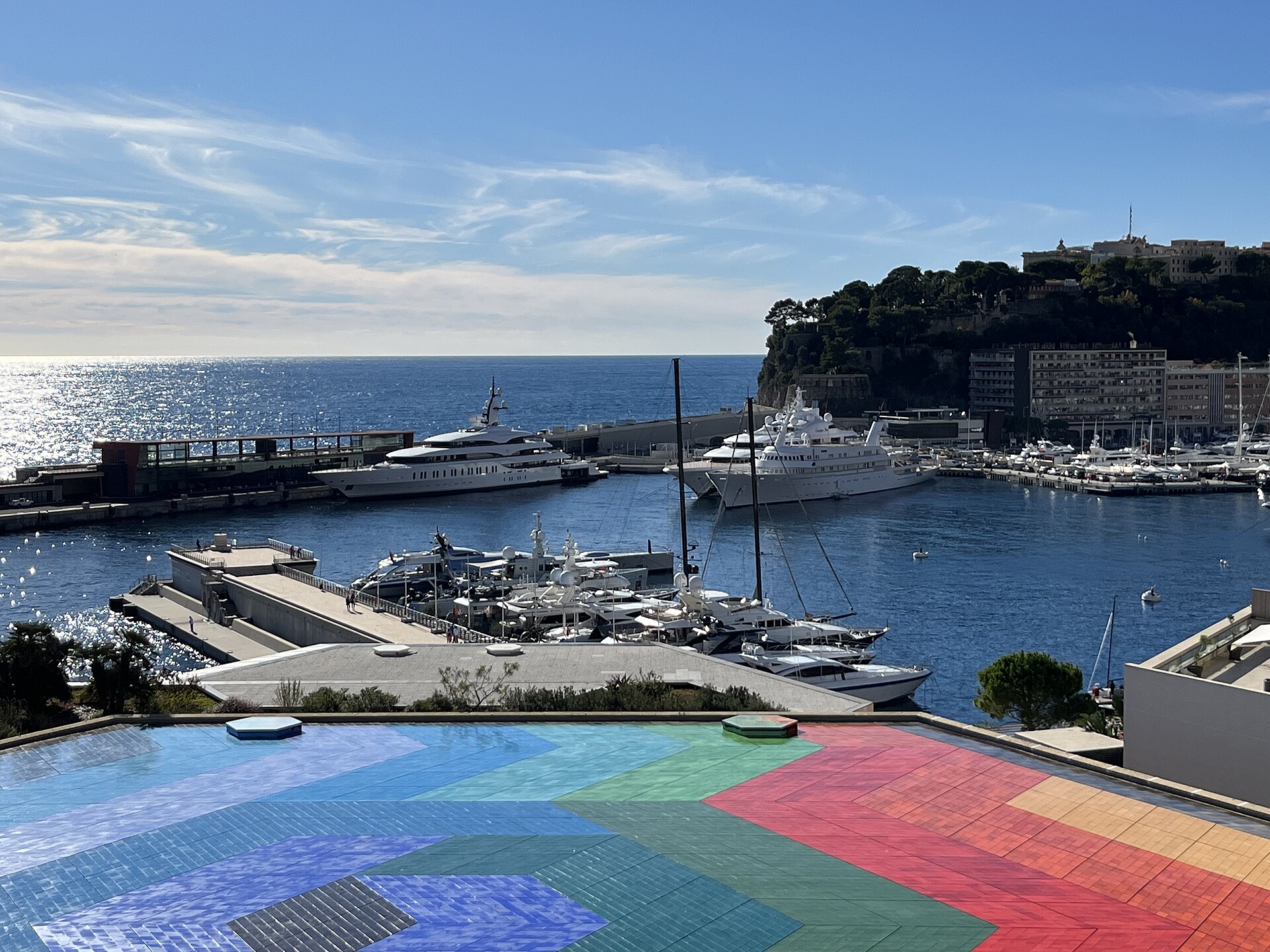
And then there is the one most visitors never see. Hexa Grace, by Victor Vasarely, is Monaco’s largest artwork: some 24,000 enamelled lava tiles rippling across 1,500 square metres in Op-Art blues, greens and golds, named in honour of Princess Grace. It covers the roof of the Auditorium Rainier III — invisible from the street, revealed in full only from the casino terraces and the heights above the port. Once you know to look down, you will never miss it again.
Places


Larvotto: art with your feet in the sand
The seafront carries the collection to the water. Quatre Lances is a rare open-air Alexander Calder stabile — bolted steel blades now anchoring the new Mareterra quarter at the Larvotto end of town, the heavyweight American name in Monaco’s holdings. Along the promenade, La Petite Sirène — Kristian Dahlgård’s tribute, a gift from Monaco’s Danish community for Rainier III’s golden jubilee — echoes Copenhagen’s icon above the sand.
Keep walking and the cast grows: Gustave Dussart’s Le Pêcheur hauls his net from the sea on Avenue Princesse Grace, a reminder of what this coast was before the towers, and Bernard Bezzina’s Trois éléments rises further along the esplanade. Few cities let you alternate a Calder with a swim.
Places


Walking it: one route through the whole collection
The works above string naturally into a single route — Fontvieille’s sculpture park, up over the Rock, down to the port, up again to the Casino terraces and out along the Larvotto seafront. Our Open-Air Sculpture Trail maps it as a thirteen-waypoint route over about six kilometres; allow a generous half-day with stops, or split it at Port Hercule into two easy halves.
If you want interiors to go with the open air, the Art & Architecture walk adds the Nouveau Musée National’s two villas, and the gardens guide covers the green settings many of these works stand in. Every single stop is free — which earns the collection a proud place in our free things to do in Monaco guide.
Walks

Frequently asked questions
Is Monaco’s public art free to see?
Yes — every work in the open-air collection is free, unticketed and accessible at all hours: the sculptures in Fontvieille and the Jardins de Saint-Martin, Sky Mirror on the Place du Casino, the Calder at Mareterra and the rest. Only museums and temporary indoor exhibitions charge entry.
How many public artworks does Monaco have?
The official Chemin des Sculptures Rainier III trail catalogues more than 200 works across the principality, the legacy of Prince Rainier III’s decades of acquisitions and the Monte-Carlo International Sculpture Festival. The count keeps growing as works are added and resited — the Calder, for one, now anchors the new Mareterra quarter.
Where can I see Hexa Grace, the Vasarely mosaic?
From above — that is the catch. Hexa Grace covers the roof of the Auditorium Rainier III and is invisible from street level. The classic viewpoint is the seaward edge of the casino terraces near the Opéra, looking down towards Port Hercule; the heights above the port work too.
What are the most important artworks in Monaco’s collection?
The blue-chip names are Alexander Calder’s Quatre Lances stabile at Mareterra, Giorgio de Chirico’s Ettore e Andromaca in Monaco-Ville, Anish Kapoor’s Sky Mirror on the Place du Casino and Victor Vasarely’s rooftop mosaic Hexa Grace. Around them stand works by Arman, François-Xavier Lalanne, André Masson, Giacomo Manzù and Manolo Valdés.
Is there an official map of Monaco’s sculptures?
Yes. The Chemin des Sculptures Rainier III, run by Monaco’s cultural affairs directorate, publishes an interactive map and a full list of works, each with a QR-linked fact sheet. Our Open-Air Sculpture Trail walk condenses it into a single half-day route through the essentials.